
AFRICAN AMERICAN HISTORY

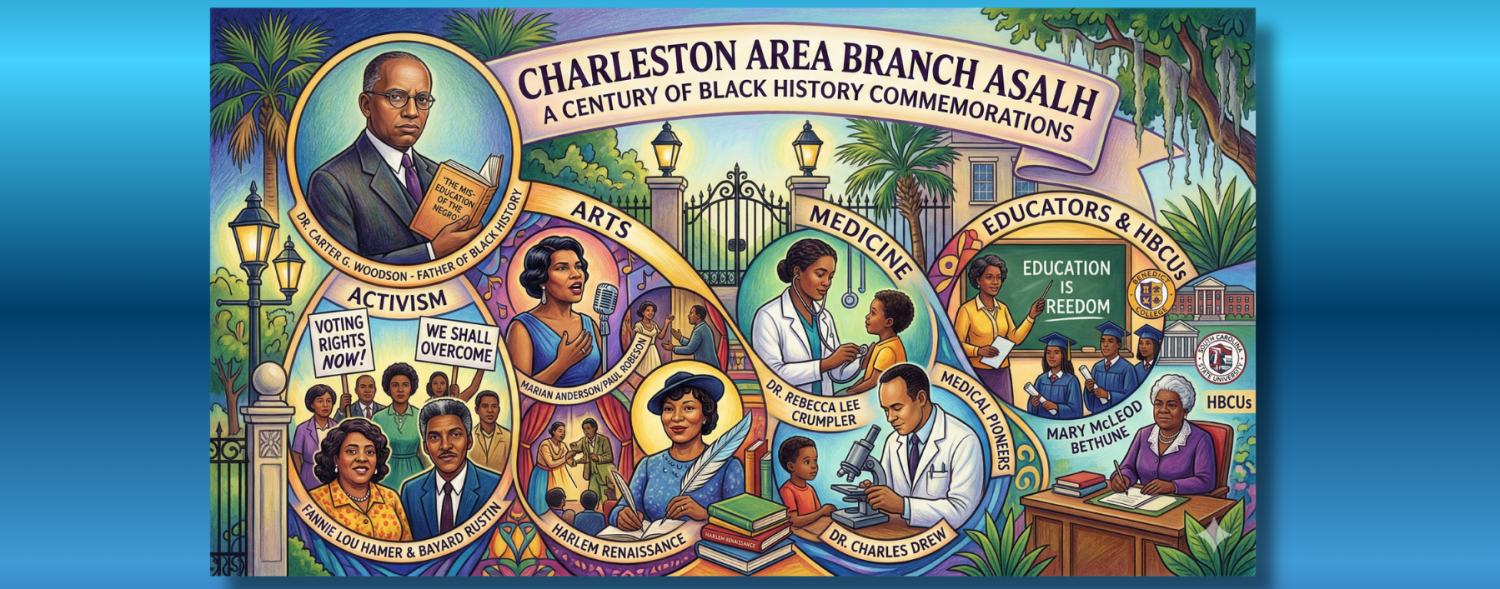
The Association for the Study of African American Life and History (ASALH) aspires to be the leading organization dedicated to Black heritage. They aim to achieve this through a strong network of branches and partnerships, fostering diversity and inclusion within their membership. Their core mission is to actively promote, research, preserve, and share information about Black life, history, and culture for a global audience.
The Charleston Library Society
Established in 1748, is one of the oldest subscription libraries in the U.S. Located in a historic building, it houses a vast collection of rare books and manuscripts. Beyond being a repository of knowledge, it serves as a cultural hub, hosting events and exhibitions that celebrate literature and the humanities. With a commitment to lifelong learning, it inspires and enriches the community.


The Green Book of South Carolina
The Green Book of South Carolina is a mobile guide to over 300 African American cultural sites across all 46 counties in the state. Created by the S.C. African American Heritage Commission, it offers detailed narratives, images, and directions for historic districts, markers, and more. Users can customize itineraries and explore sites linked to the Civil Rights Movement, the Gullah Geechee Corridor, and African American history.
This resource is dedicated to offering reliable information on the history of Black people worldwide, with a focus on North America. Its mission is to foster a deeper understanding of the shared human experience by highlighting the diversity of the Black experience and the widespread presence of Black communities globally. It is recognized as the largest online encyclopedia of African American and Global African history.

AFRICAN AMERICAN ART

The Charleston Gaillard Center is a premier cultural hub that supports multidisciplinary arts programming and provides a platform for local, national, and global artists. Dedicated to fostering community connections, the Gaillard Center collaborates with nonprofits and community groups to inspire dialogue and amplify underrepresented Black histories through festivals, productions, programs, and curriculum guides.
The Colour of Music Festival, Inc. celebrates the contributions of Black classical composers and performers, presenting baroque, classical, and 20th-century music nationwide. Founded in Charleston in 2013, the festival has expanded to cities like Atlanta and Houston, spotlighting overlooked composers like Le Chevalier de Saint-Georges and providing opportunities for Black classical artists.

GULLAH CULTURE

Gallery Chuma in Charleston, SC, is a premier virtual and physical art space dedicated to the vibrant culture of the Gullah people of coastal South Carolina. The gallery showcases works by internationally acclaimed Gullah artists and an innovative group of emerging talents, offering a unique opportunity to explore Gullah heritage through art, books, crafts, storytelling, spirituals, tours, and food.
GULLAH GEECHEE CULTURAL HERITAGE CORRIDOR COMMISSION
The Gullah Geechee Cultural Heritage Corridor, a National Heritage Area managed by the U.S. National Park Service, preserves and shares the history, culture, and heritage of the Gullah Geechee people across coastal North Carolina, South Carolina, Georgia, and Florida. It highlights their traditional practices, historic sites, and natural resources, celebrating their nationally significant legacy.


GGG, Inc., a 501(c)(3) nonprofit since 2010, supports the Gullah Geechee Cultural Heritage Corridor (South Carolina, North Carolina, Georgia, Florida) and the African diaspora. Its mission includes educating about Gullah Geechee history and heritage and addressing cultural, historical, and social topics through programs like the Mende Cultural Arts Film Festival, Bridge the Gap school initiatives, and Heirs Property assistance to retain Black land ownership.
EDUCATIONAL INSTITUTIONS
The Avery Research Center for African American History and Culture in Charleston, SC, preserves and promotes African American history and heritage in the Lowcountry. Founded in 1865 as the Avery Normal Institute, a school for African American students, it now houses archives, artifacts, and exhibitions. The center is a hub for education, research, and public events celebrating African American contributions and culture.


The College of Charleston is a vital resource for exploring African American history and culture through its innovative African American Studies program, one of the newest majors on campus. This interdisciplinary program draws from nine academic disciplines, including anthropology, sociology, history, and theater, to provide students with a rich, engaged learning experience. Faculty are deeply committed to educational excellence and social responsibility, encouraging students to critically examine African American history, culture, and the complexities of a multi-ethnic world.
CENTER FOR THE STUDY OF SLAVERY (CSSC) (College of Charleston)
“Through scholarly research and public programming, the Center for the Study of Slavery (CSSC) examines the impact of slavery and race-related issues in the City of Charleston, including the surrounding region, and at the College of Charleston from the late 18th century through the civil rights era and the continued impact and legacy of slavery in the present.”


INDIANA UNIVERSITY (Archives of African American Music and Culture
The Archives of African American Music and Culture (AAAMC), established in 1991, is a repository documenting African American musical genres and cultural expressions from the post-World War II era. Its collections span blues, gospel, R&B, hip-hop, classical music, and Black radio. The AAAMC supports scholars, students, and the public with access to oral histories, photographs, manuscripts, recordings, and personal papers, alongside public events, publications, and educational resources.
UNIVERSITY OF SOUTH CAROLINA – Digital Library
The USC Digital Library houses nearly 300 digital collections, including materials from six special collections units on campus. Continuous digital preservation ensures that USC’s research and teaching resources are accessible worldwide. Highlights include the WPA Slave Narrative Collection, offering valuable insights into African American history.

ONLINE LIBRARIES & ARCHIVES
DIGITAL PUBLIC LIBRARY OF AMERICA
“The Digital Public Library of America (DPLA) is committed to broadening access to our collective history, culture, and knowledge, aiming to create a more inclusive and informed society. Collaborating with libraries, archives, museums, and cultural institutions nationwide, DPLA provides a centralized platform for discovering millions of materials. It also assists libraries in procuring and disseminating ebooks and e-content, while fostering collaboration among library leaders to advance technologies that serve and empower their communities. Through these endeavors, DPLA endeavors to amplify the impact of libraries as trusted sources of shared information and advocate for equitable access to resources for all.”
“The Internet Archive, a 501(c)(3) non-profit, is building a digital library of Internet sites and other cultural artifacts in digital form. Like a paper library, we provide free access to researchers, historians, scholars, people with print disabilities, and the general public. Our mission is to provide Universal Access to All Knowledge.”
The Library of Congress, the world’s largest library and research arm of the U.S. Congress, houses extensive collections, including books, films, maps, and manuscripts. Its online archive, “Born in Slavery,” features over 2,300 firsthand slave narratives and photographs collected by the Federal Writers’ Project in the 1930s. Digitized in 2000–2001, this collection provides invaluable insights into the lives of formerly enslaved individuals, including those from South Carolina.
NATIONAL ARCHIVES (African American Heritage Collection)
“The Archives holds a wealth of material documenting the Black experience. This page highlights these resources online, in programs, and through traditional and social media. “The Archives holds a wealth of material documenting the Black experience. This page highlights these resources online, in programs, and through traditional and social media.
THE NATIONAL MUSEUM OF AFRICAN AMERICAN HISTORY AND CULTURE (Smithsonian)
“The National Museum of African American History and Culture is the only national museum devoted exclusively to the documentation of African American life, history, and culture. It was established by an Act of Congress in 2003, following decades of efforts to promote and highlight the contributions of African Americans. To date, the Museum has collected more than 40,000 artifacts and nearly 100,000 individuals have become members. The Museum opened to the public on September 24, 2016, as the 19th museum of the Smithsonian Institution.”
SMITHSONIAN INSTITUTION (open access media)
Where you can download, share, and reuse millions of the Smithsonian’s images—right now, without asking. With new platforms and tools, you have easier access to more than 4.9 million 2D and 3D digital items from our collections—with many more to come. This includes images and data from across the Smithsonian’s 21 museums, nine research centers, libraries, archives, and the National Zoo.
Drawing on extensive archival records, this digital memorial allows analysis of the ships, traders, and captives in the Atlantic slave trade. The SlaveVoyages website is a powerful resource for understanding the history of the transatlantic and intra-American slave trade. It represents decades of research by scholars around the world who combed through libraries and archives. Created by a team of historians, librarians, and web specialists, the website took three years to develop and launch. Funding came from the National Endowment for the Humanities and the website is currently hosted at Rice University.
AFRICAN AMERICAN NEWSPAPERS
The Afro-American newspaper, founded in 1892 by John Henry Murphy Sr., a former slave, has been a champion for racial equality and economic opportunity for Black Americans for over 130 years. Murphy, merging church publications, started a one-page weekly that grew into the most prominent Black paper on the Atlantic coast. By 1922, it challenged Jim Crow laws in Maryland. After Murphy’s death, his sons, trained in the newspaper business, continued his legacy.
AFRICAN AMERICAN BUSINESS & TOURISM
Support Black-Owned Businesses: 450+ Places to Start Online – Blog by Sophia Conti
NABHOOD: Black Owned Hotels US And Caribbean – Advocating for Minority Ownership, and Development
AFRICAN AMERICAN HISTORY BOOKS & MEDIA
Recommended Resources on African & African American History by Professor Donald West
| Category | Title | Author/Director | Details |
|---|---|---|---|
| General Readings | From Slavery to Freedom: A History of African Americans | John Hope Franklin & Evelyn Brooks Higginbotham | A comprehensive overview of African American history. |
| The African American Odyssey | Darlene Clark Hine, William C. Hine, & Stanley Harrold | Highlights key moments in African American history and culture. | |
| Before the Mayflower: A History of Black America | Lerone Bennett, Jr. | Chronicles African American history from its beginnings to the present. | |
| Africa in World History: From Prehistory to the Present | Erik Gilbert & Jonathan T. Reynolds | Explores Africa’s role in global history. | |
| Africana: The Encyclopedia of the African and African American Experience | Kwame Anthony Appiah & Henry Louis Gates, Jr. | A comprehensive encyclopedia of African and African American heritage. | |
| Black Folk—Here and There: Vol. I & II | St. Clair Drake | Examines the cultural and social dynamics of Black communities globally. | |
| The History of Africa: The Quest for Eternal Harmony | Molefi Kete Asante | A deep dive into African history and its enduring cultural influence. | |
| Give Me Liberty! An American History | Eric Foner | Focuses on liberty and equality in American history. | |
| Transatlantic Slave Trade | The Atlantic Slave Trade: A Census | Philip Curtin | Analyzes the scale and impact of the transatlantic slave trade. |
| The African Slave Trade | Basil Davidson | Offers insights into the history and consequences of the African slave trade. | |
| Forced Migration: The Impact of the Export Slave Trade on African Societies | Joseph E. Inikori | Examines the effects of slavery on African societies. | |
| Black Cargo: A History of the Atlantic Slave Trade | Daniel P. Mannix & Malcolm Cowley | A detailed history of the transatlantic slave trade. | |
| Captives as Commodities: The Transatlantic Slave Trade | Lisa Lindsay | Explores the economic and human dimensions of the slave trade. | |
| Africa and Africans in the Making of the Atlantic World, 1400–1800 | John Thornton | Highlights Africa’s influence on the Atlantic world. | |
| Many Thousands Gone: The First Two Centuries of Slavery in North America | Ira Berlin | Chronicles the early history of slavery in North America. | |
| Strange New Land: African Americans 1617–1776 | Peter Wood | Discusses African American life during the colonial period. | |
| Rice and Slaves: Ethnicity and the Slave Trade in Colonial South Carolina | Daniel C. Littlefield | Examines the connection between rice cultivation and slavery in South Carolina. | |
| Slavery at Sea: Terror, Sex, and Sickness in the Middle Passage | Sowande M. Mustakeem | Investigates the brutal conditions of the Middle Passage. | |
| The Gullah: Rice, Slavery, and the Sierra Leone-American Connection | Joseph A. Opala | Links Gullah culture to Sierra Leone’s heritage. | |
| Transatlantic Africa: 1440–1888 | Kwasi Konadu | A comprehensive history of Africa’s transatlantic connections. | |
| Deep Roots: Rice Farmers in West Africa and the African Diaspora | Edda L. Fields-Black | Explores the agricultural practices and cultural connections of African rice farmers. | |
| Films | Africans in America: America’s Journey Through Slavery (4-part series) | Bagwell & Bellows | A series chronicling slavery in America. |
| Amistad | Steven Spielberg (Director), Debbie Allen (Producer) | A historical drama about the famous Amistad case. | |
| Family Across the Sea | Tim Carrier & SCETV | Explores connections between the Lowcountry and Sierra Leone. | |
| Prince Among Slaves | Andrea Kalin (Director), narrated by Mos Def | The story of an African prince sold into slavery in 1788. | |
| The Language You Cry In | Narrated by Vertamae Grosvenor | Traces Gullah roots to Sierra Leone through song. |